

Asphalt vs. Concrete: Which is Better for Phoenix Commercial Lots?

For commercial property managers in the Salt River Valley, the decision between asphalt and concrete isn’t just about aesthetics, it’s about how your investment will stand up to Arizona’s punishing environment. With surface temperatures often exceeding 160°F during the summer, choosing the wrong material can lead to premature failure, safety hazards, and ballooning repair costs.
In this guide, we break down the critical differences between these two materials specifically through the lens of the Phoenix climate and commercial ROI.
How Asphalt and Concrete Respond to Phoenix Heat
The “Urban Heat Island” effect in Phoenix creates a unique challenge for pavement. Unlike cooler climates where freeze-thaw cycles are the main concern, here, UV radiation and extreme heat are the primary drivers of damage.
Asphalt: Flexibility in the Heat
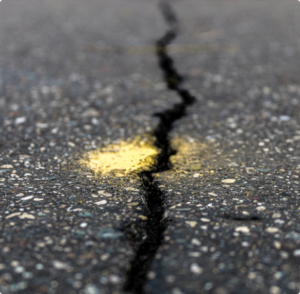
Asphalt is a “flexible” pavement. This flexibility is a major advantage in Phoenix because it allows the surface to expand and contract with dramatic temperature swings without cracking as easily as rigid materials. However, the intense sun causes oxidation, which breaks down the binders and makes the asphalt brittle over time. Without a proactive maintenance plan, untreated asphalt can quickly develop “alligator cracking” or rutting under heavy truck loads.
Concrete: The Rigid Competitor
Concrete is highly durable and reflects sunlight, which helps it stay slightly cooler than asphalt. It does not soften with heat, making it an excellent choice for heavy-load areas like loading zones and industrial bays. However, its rigidity means that any shifting in the sub-base or extreme thermal expansion can lead to deep, structural cracks that are significantly more expensive to repair than asphalt.
Asphalt vs. Concrete Cost Comparison (2025 Update)
When evaluating commercial paving services, budget is always a factor. According to current 2025 industry pricing data, asphalt remains the most cost-effective entry point for large-scale Arizona infrastructure.
| Feature | Asphalt Paving | Concrete Paving |
|---|---|---|
| Initial Cost | 35% – 45% lower upfront | Significantly higher initial cost |
| Phoenix Installation | $7 – $13 per square foot | $8 – $20 per square foot |
| Material Cost | $100 – $200 per ton (Hot-Mix) | $125 – $175 per cubic yard |
| Installation Time | 24–48 hours for traffic | 7+ days curing time |
| Typical Lifespan | 15–20 years (w/ maintenance) | 30–50 years |
| Maintenance | Requires sealcoating every 2–3 years | Minimal (periodic joint sealing) |
Note on Market Volatility: As a petroleum-based product, asphalt prices are closely tied to crude oil fluctuations. Historically, for every 1% rise in crude oil prices, asphalt costs can increase by approximately 0.7%. In early 2025, the Arizona market has seen a 2.1% rise in construction material costs, making proactive budgeting more essential than ever.
Asphalt vs. Concrete Maintenance & Repair in Phoenix
A well-maintained parking lot is a key part of your business curb appeal and safety.
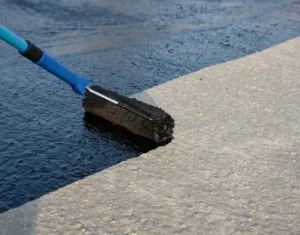
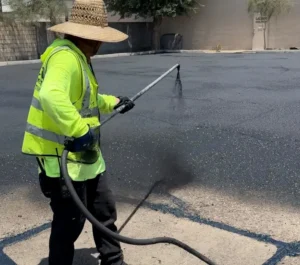
Asphalt Maintenance: Because it is petroleum-based, asphalt needs a “sunscreen” (known as sealcoating) to protect it from UV rays. Regular sealcoating and crack sealing can effectively double its lifespan.
Repairing Damage: Asphalt repairs, such as pothole patching, are fast and cost-effective. Concrete repairs often require full panel replacement, leading to longer business downtime and higher labor costs.
Which One Should You Choose?
Choose Asphalt If:
- You have a large area (like a retail parking lot) and want to maximize your budget.
- You cannot afford to close your business for more than a day or two.
- You want a smooth, dark finish that enhances pavement markings and striping.
Choose Concrete If:
- You have high-stress areas like loading docks or dumpster pads.
- You want a “set it and forget it” solution with minimal ongoing maintenance.
- You are prioritizing long-term property value over immediate cost savings.
FAQs Related to Asphalt vs. Concrete in Phoenix
Both materials have advantages. Concrete stays cooler by reflecting sunlight, but can be prone to structural cracking. Asphalt is a “flexible” pavement that handles Arizona’s temperature swings well, provided it receives regular sealcoating to prevent UV-driven brittleness.
explore our recent